Sierra Stayed With a Trapped Child While Her Team Found a Way to Send Help
No confirmed account. No confirmed location. Just a very young child alone in an elevator who needed someone to help her.
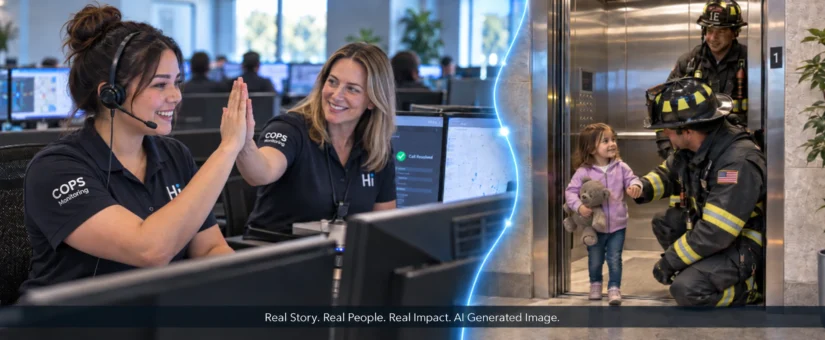
Sierra answered an elevator call and immediately realized this was not going to be a normal alarm.
On the other end was a child so young she could not speak in full sentences.
She was alone.
She was looking for her mother.
And she needed help.
Normally, an elevator call gives a dispatcher the information needed to identify where the call is coming from.
This one didn’t.
The account number Sierra received wasn’t usable. The telephone number associated with the elevator did not match an account in the monitoring system. There was no confirmed address Sierra could give the fire department.
But Sierra did have one thing that mattered most.
She had the child on the phone.
Sierra immediately got her manager involved and lowered her voice to communicate at the child’s level.
“Is your mommy or daddy with you?”
There was no address to read back.
No adult who could explain the location.
No simple procedural path that could fill in what was missing.
So Sierra and her manager stopped waiting for information they didn’t have and started working with the information they did.
A business name. An area code. And Human Intelligence.
The team had the name associated with the call and the area code from the elevator dialer.
While Sierra stayed connected with the little girl, her manager began searching for possible locations.
They narrowed the possibilities to two properties in Pennsylvania.
That changed everything.
A call that had arrived without a confirmed location now had somewhere for emergency responders to go.
Sierra’s manager contacted the fire department, explained the unusual circumstances, and provided the information they had developed.
The fire department was dispatched to check the possible locations. Nominations
Sierra’s job still wasn’t finished.
While her manager worked on getting help moving, Sierra remained focused on the child.
“What’s your name?”
“Can you hear me?”
She kept communicating.
She reminded the little girl that she wasn’t alone.
Eventually, Sierra was able to determine that the child was looking for her mother.
And for approximately 12 minutes, Sierra stayed with her while the team worked the problem around her.
Then the line went silent.
The call disconnected.
Sierra immediately tried to reconnect to the elevator.
She couldn’t.
But by then, the team had accomplished something that had seemed nearly impossible when the call first arrived.
They had turned an elevator call with no confirmed account and no confirmed address into an active emergency response.
That’s where Human Intelligence changed the outcome.
A database couldn’t identify the elevator.
The child couldn’t provide the location.
The normal information a dispatcher depends on wasn’t available.
But Sierra and her manager didn’t treat missing information as the end of the process.
They treated it as a problem to solve.
Sierra adjusted how she communicated because the person who needed her was a very young child.
She immediately brought in another person who could help solve the larger problem.
Her manager combined the fragments they had into two possible locations.
Together, they gave the fire department somewhere to respond.
And Sierra stayed with the child for as long as the connection allowed.
The nomination does not document what happened after responders were dispatched. What it does document is the difference COPS made before that point: a child who could not tell anyone where she was went from having no identifiable location to having emergency responders sent to look for her.
That is not simply answering an elevator phone.
That is judgment. Compassion. Critical thinking. Communication. Teamwork.
And the determination to keep looking for a solution when the normal one isn’t available.
That’s COPS Human Intelligence™ in Action.

Choose monitoring with people who keep looking for a way to help when the obvious path isn’t there.
Because when something unexpected happens to your customer, the difference may come down to whether the person representing your company says “We don’t have enough information” or starts asking “What information do we have, and what can we do with it?”