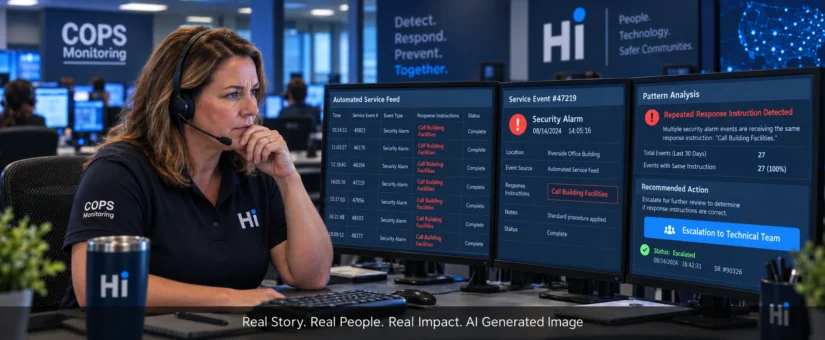
Donna Connected Two Warning Signs and Helped Uncover a Larger Problem
Two unusual response instructions appeared in two different services. Donna recognized the pattern, spoke up, and helped uncover an intermittent issue with the potential to affect future alarms.
Sometimes the most important warning isn’t an alarm.
It’s the moment when an experienced monitoring professional looks at what a system is telling them and realizes:
Something doesn’t make sense.
Donna encountered one of those moments while handling a specialized alarm from a delivery driver.
She attempted to contact the driver but could not reach them.
Based on her experience handling these alarms, Donna expected the next step to involve dispatching assistance to the driver’s location.
Instead, the response instructions on her screen directed her to log the alarm without dispatching.
The instruction was unexpected. Donna didn’t ignore that.
Response plans can contain requirements a dispatcher may not see behind the scenes. So Donna did exactly what she should have done.
She brought the discrepancy to her shift manager.
After they reviewed the situation, Donna followed the configured instructions.
At that point, the event could reasonably have been considered an isolated exception.
Donna remembered it.
Not long afterward, she received another activation from a completely different service.
Again, the response instructions unexpectedly directed her to log the alarm without police dispatch.
One unusual instruction could have had an explanation.
The same unusual behavior appearing in two different services was harder to dismiss.
Donna connected the two events.
She recognized that the similarity could point to something larger and escalated it immediately.
Her manager arranged for the events to be reviewed with the integration provider.
The investigation confirmed an intermittent technical issue that was causing response instructions to be written incorrectly into the monitoring system.
Once identified, the issue was corrected.
Donna had personally encountered only two alarms.
What she noticed had the potential to matter to many more.
Experience isn’t only knowing what to do. It’s knowing when something doesn’t look right.
Donna did not disregard the first instruction simply because it surprised her.
She questioned it appropriately, involved her manager, and then followed the response plan after review.
What made the second event different was context.
Donna remembered the first and recognized the similarity.
And she understood that two unusual events across different services deserved broader investigation.
Technology connected the alarms and delivered the instructions.
Donna supplied the pattern recognition.
That combination helped identify and correct an intermittent issue before it could continue affecting future alarm handling.
That’s COPS Human Intelligence™ in Action.

Choose a Monitoring Partner Whose People Know When Something Deserves Another Look
Your customers depend on increasingly sophisticated monitoring technology, integrations, and automated information.
You also depend on the people behind those systems to understand the operation well enough to recognize when the information in front of them doesn’t fit.
Donna didn’t simply process two unusual events. She connected them.
For your company and your customers, that kind of experience can turn one strange alarm into the discovery that protects what happens next.