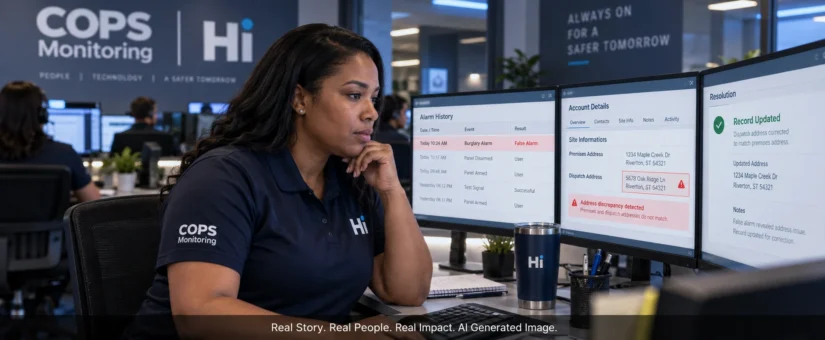
Destinee Found the Address Problem a False Alarm Exposed
The fire alarm was false. The location problem it exposed was not. Destinee kept investigating until the correct address could be established for future emergency response.
A false alarm can still reveal something that matters.
Destinee discovered that during a commercial fire alarm at a bakery.
The fire department told her the address being provided did not lead to the bakery.
It led to another nearby business.
The alarm itself ultimately proved false.
The address problem did not.
Destinee understood that “no fire” did not mean “no problem.”
She first confirmed that the information she had given the fire department matched the address on the monitoring account.
It did.
She attempted to reach the responsible parties and then contacted the alarm dealer.
The dealer had recently been at the bakery performing repairs and reasonably believed the address information should be correct.
At that point, the immediate alarm had been resolved.
Destinee could have stopped there.
She didn’t.
She independently checked available mapping information and confirmed what the fire department had experienced.
The address on the account corresponded to the other business, not the bakery.
Further investigation revealed why.
The numeric portion of the address had been transposed.
The cross street was also incorrect.
Now there was no ambiguity.
The information could be corrected so responders would have the bakery’s actual location if they were needed again.
Destinee didn’t let the outcome of this alarm hide what it had exposed.
That is what made her response different.
The fact that there was no fire made the immediate event less urgent.
It did not make accurate emergency-response information any less important.
In fact, the false alarm created an opportunity.
The problem surfaced during an event when no active fire existed, giving Destinee the chance to investigate before that location information might be needed during a real emergency.
She also treated the discrepancy as something to solve, not something to simply pass along.
The monitoring account, the dealer’s understanding, the fire department’s experience, and the mapping information did not initially align.
Destinee kept working until they did.
Professional monitoring depends on technology, accurate information, alarm dealers, monitoring professionals, and emergency responders all working together.
When one piece doesn’t fit, someone has to notice.
Destinee noticed.
Then she kept going until she understood why.
That’s COPS Human Intelligence™ in Action.

Choose a Monitoring Partner That Looks Beyond Today’s Alarm
Your customers depend on accurate information being available when emergency responders need it.
When an alarm exposes something that could affect a future response, you want a monitoring partner whose people recognize the opportunity to help you correct it before the stakes are higher.
Destinee didn’t just help resolve a false alarm.
She helped uncover information that could make the next response better.
For your company and your customers, the best time to discover an emergency-response problem is before a real emergency depends on it.