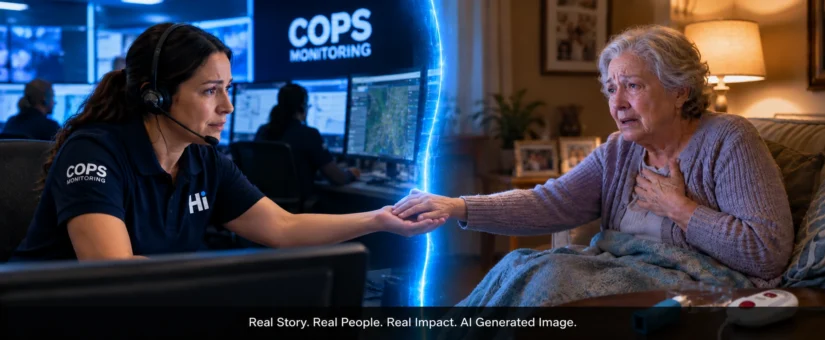
Ally Heard the Emergency Rosie Tried to Hide
Rosie said she did not need help. Ally heard something different, asked again, uncovered an asthma attack, and stayed with her until EMTs were inside.
Rosie told Ally that she had pressed her medical alert button by accident.
She did not need assistance.
“I’m fine.”
Those words could have ended the call.
Ally was listening to more than the words.
Rosie’s voice sounded raspy. Her breathing did not sound right.
So Ally asked again.
This time, Rosie admitted that she might be having an asthma attack.
She was alone.
She was paralyzed.
She had exhausted herself coughing and was struggling to breathe.
Even then, Rosie hesitated to accept help.
Ally did not let “I’m fine” become the end of the response.
She did not pressure Rosie. She calmly explained why she wanted to help.
“I don’t want to leave you in an asthma attack. I’d like to send you some help.”
Rosie agreed.
While a teammate coordinated emergency assistance, Ally stayed with her and began thinking about what responders would need when they arrived.
Because Rosie was paralyzed, Ally obtained the door code that would allow EMTs to enter the home.
Then she asked whether Rosie had an inhaler or nebulizer.
That question uncovered another part of the emergency.
Rosie began to cry.
She had very little medication left in her inhaler. She was afraid to use it because she could not afford to replace it.
Now Ally understood even more about the person behind the alarm.
Rosie was struggling to breathe, physically unable to get herself to safety, alone, frightened, and worried that using the medication she had now might leave her without it later.
Ally kept the emergency from becoming bigger than Rosie could manage.
As Rosie’s breathing became more labored, Ally kept her focused on the moment in front of her.
“Rosie, I know you’re upset, but I need you to focus on your breathing.”
Rosie listened.
Her crying began to ease as she concentrated on each breath.
Ally stayed connected as the ambulance sirens grew closer, reassuring Rosie that she would remain with her until responders made it inside.
Only after EMTs entered the home did Ally disconnect.
A later follow-up confirmed that Rosie went to the hospital for treatment.
The emergency was there before Rosie was ready to call it one.
That is what makes Ally’s response so important.
An acceptable response could have taken Rosie’s first answer at face value: accidental activation, no assistance needed.
Ally heard the strain behind that answer.
She asked one more question.
That question uncovered the asthma attack.
Her empathy helped Rosie accept assistance.
Her foresight helped make sure EMTs could get through the door.
And her reassurance gave Rosie a steady human connection while she struggled to breathe and waited for help.
Ally heard what Rosie’s words did not say.
That is a distinctly human part of monitoring.
Technology connected Rosie with COPS.
Ally brought the judgment to recognize that “I’m fine” did not match what she was hearing, the communication to earn Rosie’s trust, and the compassion to stay emotionally present until help physically reached her.
That’s COPS Human Intelligence™ in Action.

What if one of your customers says, “I’m fine,” but something does not sound right?
You want the person representing your company to respect what your customer says.
You also want someone attentive enough to hear the raspiness, hesitation, fear, or strain that says there may be more to the story.
Because sometimes the most important question in an emergency is the one someone chooses to ask after your customer says everything is fine.
Choose a monitoring partner whose people listen beyond the first answer.
When your customer has trouble explaining what they need, minimizes what is happening, or hesitates to accept help, you want someone like Ally on the other end of the connection: someone who listens closely enough to recognize what the words alone may miss.
When COPS answers for you, that kind of Human Intelligence can help turn “I’m fine” into the help your customer actually needs.